Back

Accessibility UX - UX Research - Interaction Design

Deaf Connect makes critical hospital communication visual, direct, and continuous.

A mobile healthcare experience connecting accessible appointment booking, sign-language translation, and visual follow-up care.

Role
Product Designer
Scope
Research, UX, UI, Accessibility
Team
Individual Project
Tools
Figma, Illustrator
Timeline
3 Months
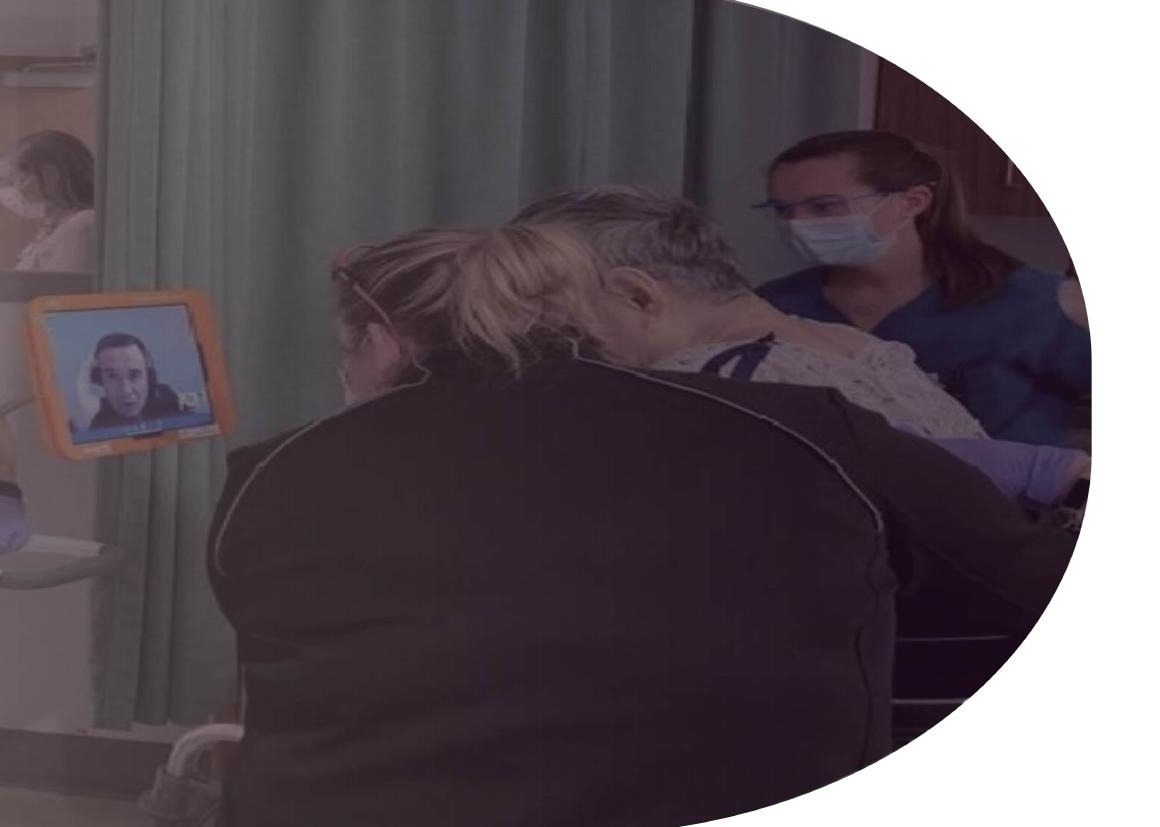
A deaf patient using remote interpretation during a hospital visit
Breaking the Communication Barrier Equal care starts with equal access to information.

Overview

The Context

Hospital visits depend on rapid spoken exchanges: patients describe symptoms, staff give directions, doctors explain diagnoses, and pharmacies confirm treatment. Deaf patients are often expected to bridge each gap themselves.

Deaf Connect reframes accessibility as a complete care journey rather than a single translation feature, supporting the patient before, during, and after the appointment.
What I Did

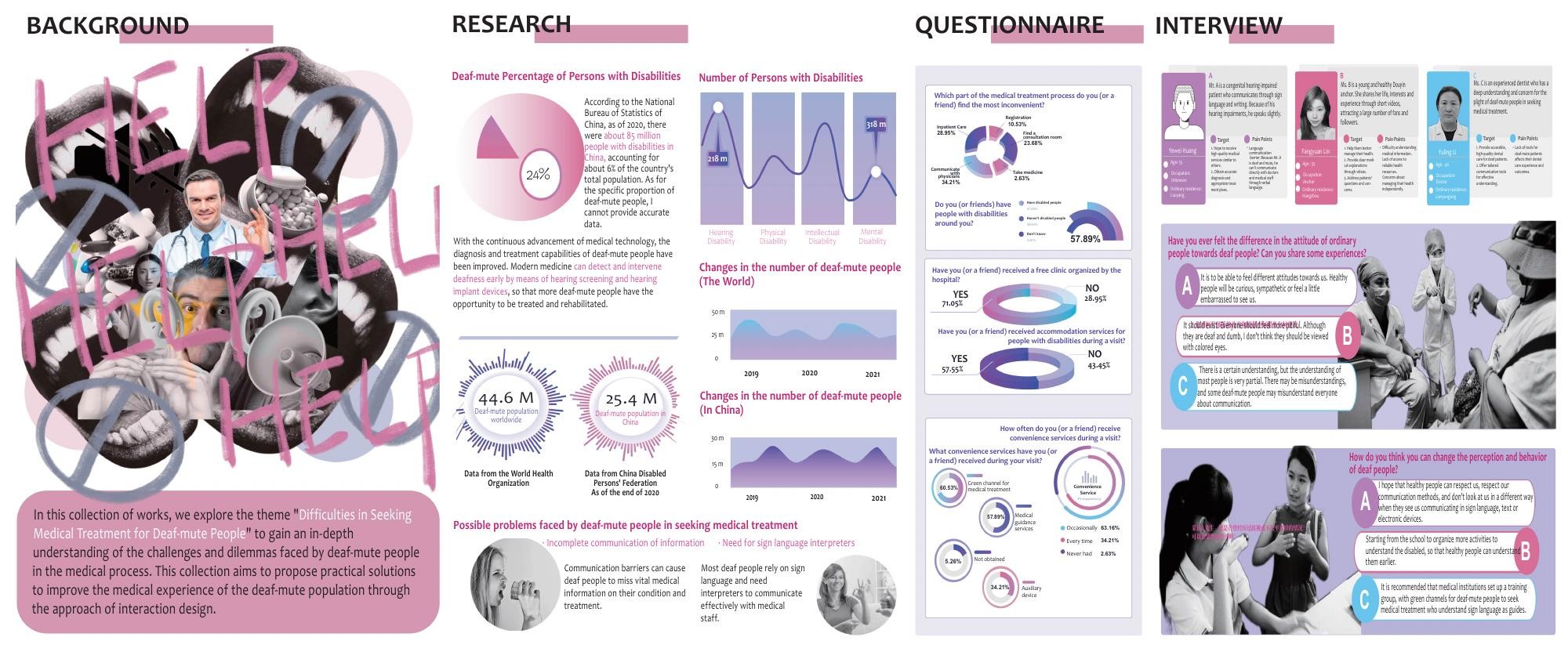
I combined background research, a questionnaire, and three stakeholder interviews to map where communication breaks down across the hospital experience.

I translated the findings into a service blueprint, a custom visual language, low-fidelity flows, and a high-fidelity mobile prototype centered on sign and text conversion.

Problem

Deaf patients must communicate critical health information inside a system built around hearing and speech.

A missed symptom, unclear direction, or misunderstood prescription is not a minor inconvenience. Each communication failure can reduce independence, increase anxiety, and affect the quality of care.

01

Information Loss

Symptoms, diagnoses, and treatment details can be incomplete when reliable interpretation is unavailable.

02

Navigation Friction

Audio announcements and spoken directions make registration and finding departments harder to complete independently.

03

Emotional Risk

Repeatedly asking for help can heighten anxiety, embarrassment, and distrust before care even begins.

Research

Where does the hospital journey break?

The research traced accessibility across the full visit, then compared where patients had to ask, explain, or confirm information without dependable support.

01
Questionnaire
02
3 Interviews
03
Journey Mapping

01 / Critical handoff

Communication with physicians

The most frequently named barrier appeared during the highest-stakes conversation: explaining symptoms and understanding medical guidance.

02 / Before care23.68%

Finding a consultation room

Wayfinding created friction before the appointment even began.

03 / Support access57.55%

Received disability accommodation

Support reached some respondents, but it was not a dependable part of every visit.

Deaf Connect research board with background data, questionnaire results, and interviews
Research artifactQuestionnaire and interview synthesis

The source board combines background research, survey findings, and stakeholder evidence used to frame the design opportunity.

Interview

Patients and providers described the same gap from different sides.

Three perspectives clarified what accessible communication must support in practice.

Patient

Mr. A, 35

Congenital hearing impairment

Uses sign language and writing, but cannot reliably explain symptoms or understand spoken medical instructions.

“Respect our communication methods instead of treating us differently.”
Community Voice

Ms. B, 35

Health content creator

Sees a need for clearer visual health education and tools that help people manage care independently.

“Understanding should begin before a patient has to ask for help.”
Provider

Dr. C, 46

Dentist

Needs dependable tools for collecting symptoms, explaining procedures, and confirming patient understanding.

“Hospitals need a clear channel designed around sign-language access.”

Persona

The primary persona came from repeated patterns in the research.

The persona combines the recurring needs described by the patient interview and questionnaire responses.

Primary Persona

Yewei, 35

Independent Deaf Patient
Behavior

Uses sign language first and writing as a fallback. Prepares questions before appointments and relies on visual confirmation.

Pain

Spoken instructions, medical terminology, and changing hospital locations make each handoff uncertain.

Need

One private, dependable way to book care, communicate symptoms, understand decisions, and retain treatment information.

Pain Points

The journey broke at three connected layers.

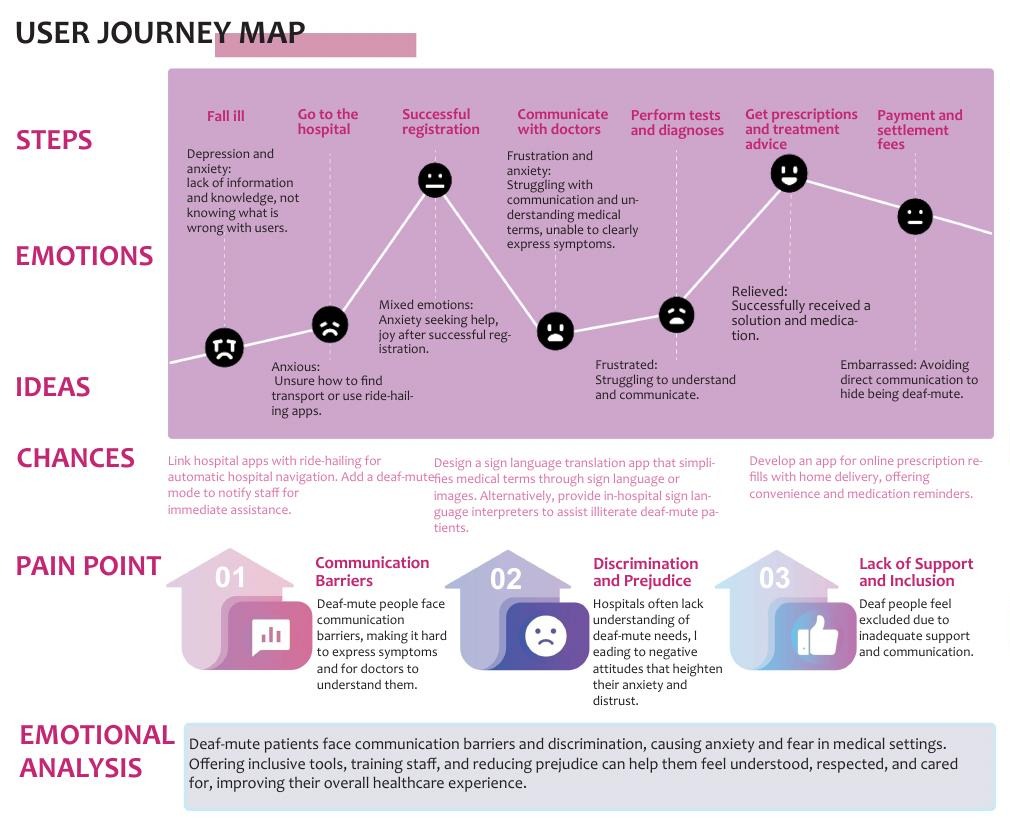
01

Communication Barriers

Patients cannot fully express symptoms or verify that medical information was understood correctly.

02

Discrimination & Prejudice

Limited staff awareness can turn a communication difference into anxiety, embarrassment, or reduced trust.

03

Lack of Support

Accessibility services are fragmented, inconsistent, and often discovered only after a problem occurs.

Journey Map

Communication anxiety peaks before diagnosis and continues into treatment.

Deaf patient hospital journey map from illness through treatment

Insight

Translation alone cannot fix a journey that loses context at every handoff.

Patients need the same information to travel with them from booking to registration, consultation, diagnosis, prescription, and follow-up. Accessibility must preserve continuity, not just convert one sentence.

The Root Cause

Hospital communication assumes every patient can hear, speak, and respond immediately.

When interpretation, visual guidance, and accessible records are treated as optional services, the patient becomes responsible for repairing the system during the most stressful moments of care.

Accessible BookingVisual GuidanceLive TranslationPersistent Care Records

Design Goal

Build one visual communication layer across the full medical journey.

Deaf Connect should help patients prepare before arrival, communicate accurately during care, and keep accessible instructions afterward without depending on a different workaround at every step.

01

Prepare

Book a doctor, record communication needs, and preview the visit.

02

Navigate

Receive visual directions, appointment status, and staff assistance.

03

Translate

Convert sign language and written text during the consultation.

04

Continue

Review diagnosis, prescriptions, and follow-up care visually.

Service Blueprint

Mapping the healthcare journey for deaf patients

Understand where communication barriers appear across the full medical journey, from appointment booking to post-treatment care.

  1. 01

    Appointment

    Patient

    Generate medical needs / Guidance consultation / Choose time and doctor

    Frontstage

    Help patients identify the correct department and doctor. Provide accessible appointment information.

    Backstage

    Verify appointment requests and doctor availability.

  2. 02

    Pre-treatment

    Patient

    Registration / See doctor / Communicate symptoms and needs

    Frontstage

    Show visit information, doctor details, visit time and location. Provide text and visual communication support.

    Backstage

    Store patient information and support real-time chat, video calls and motion translation.

  3. 03

    Mid-term Visit

    Patient

    Doctor diagnosis / Understand medical advice

    Frontstage

    Provide gesture recognition, visual feedback and text notifications. Give access to diagnosis records and long-term treatment guidance.

    Backstage

    Support communication between deaf patients and medical staff through sign-language and text systems.

  4. 04

    Treatment

    Patient

    Follow treatment plan / Cooperate with medical procedures

    Frontstage

    Use visual charts and animations to explain diagnoses and treatment plans.

    Backstage

    Manage hospital and patient data. Support remote diagnosis and video consultation.

  5. 05

    Hospital Information

    Patient

    Receive information / Sign consent forms / Understand reports and materials

    Frontstage

    Present medical materials, lab results and reports in accessible visual formats.

    Backstage

    Convert sign language into text through real-time recognition and connect the system with hospital data.

System Support

Database Management

Store and manage patient and appointment information.

Server Environment

Support hospital systems, devices and network operations.

Backend Framework

Handle business logic and data processing.

Security

User authentication and medical data encryption.

Accessibility Support

Gesture recognition, text notifications and visual communication.

Prototype

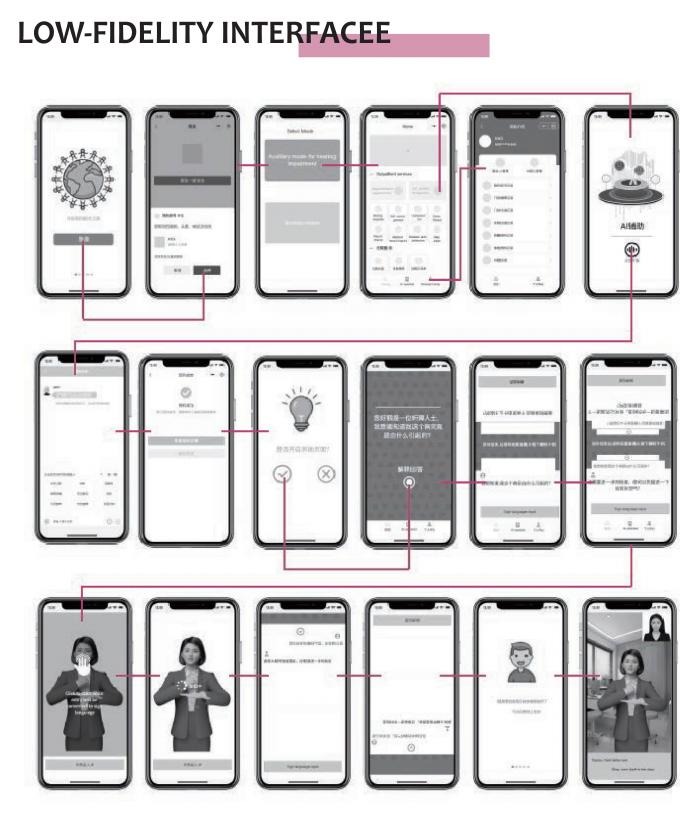
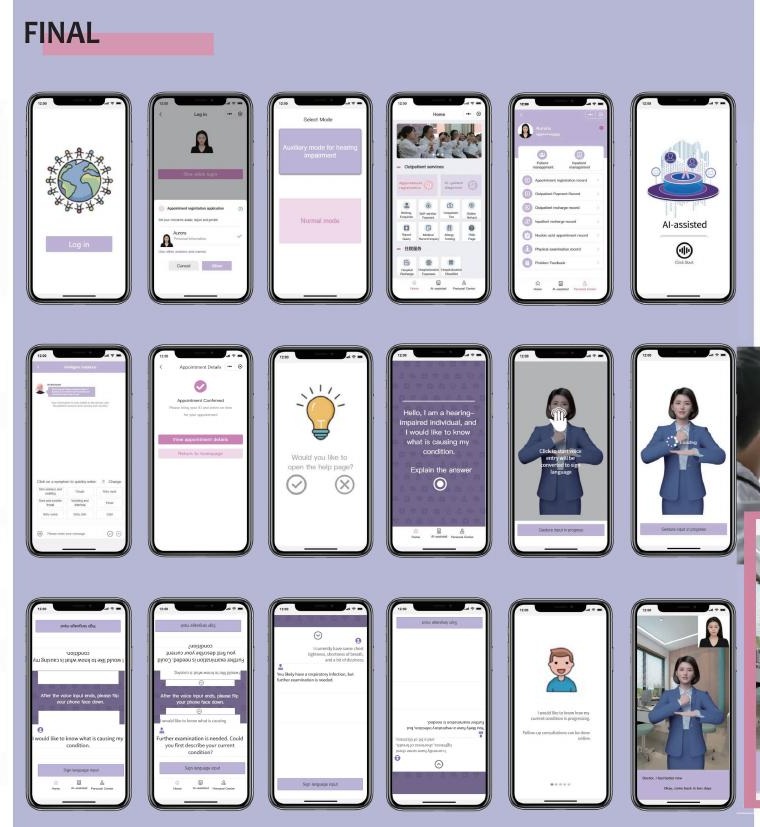
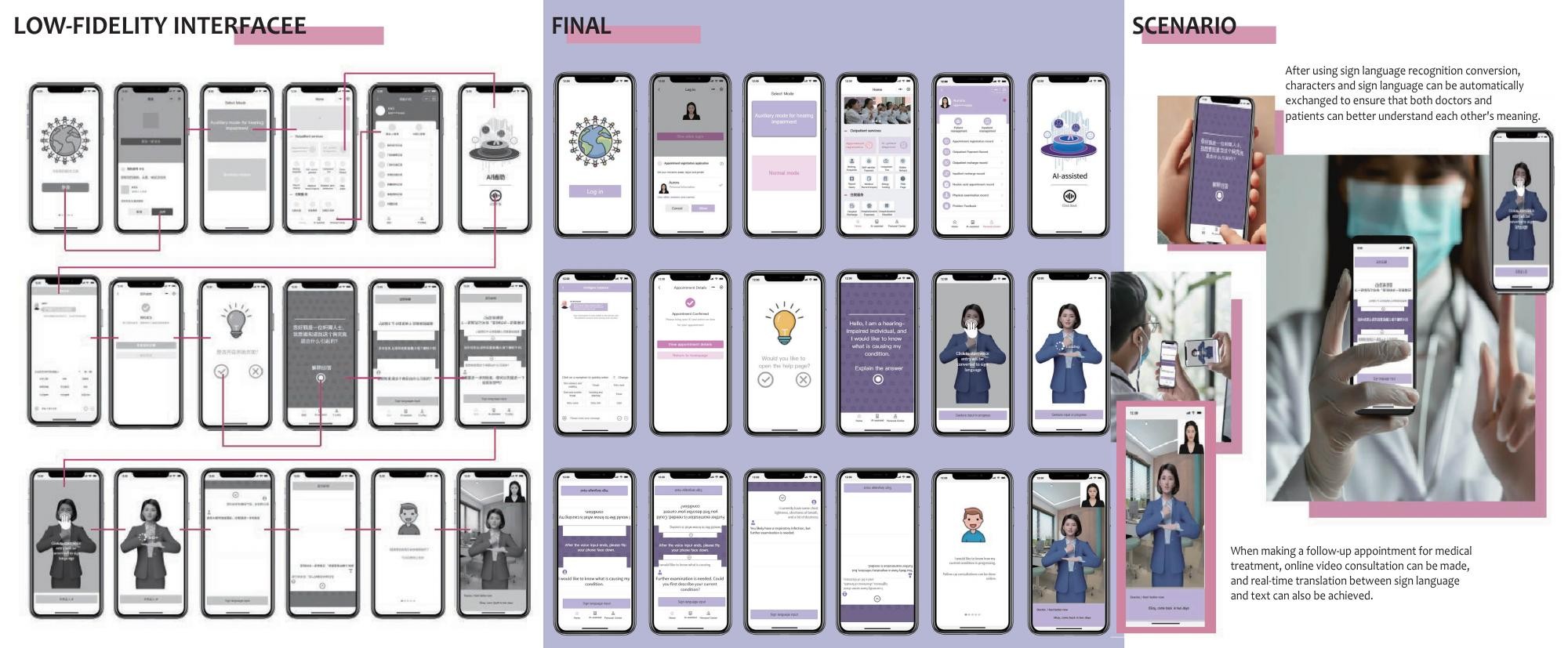
The prototype moved from a complete task flow to a focused visual system.

Low-fidelity screens established the appointment, consultation, and follow-up sequence. The final interface then clarified hierarchy, translation states, and confirmation moments.

Deaf Connect low-fidelity interface flow
Low FidelityValidate the end-to-end care flow.
Deaf Connect final mobile interface screens
Final InterfaceMake translation and next steps visible.

Final Solution

Three connected experiences support the patient before, during, and after care.

01 - Appointment & Guidance

Prepare the hospital before the patient arrives.

Patients select a doctor and time, record communication preferences, receive confirmation, and enter an accessible hospital mode with visual guidance.

  • Accessible appointment booking
  • Communication preference on record
  • Visual department and visit status
Deaf Connect appointment and hospital guidance screens

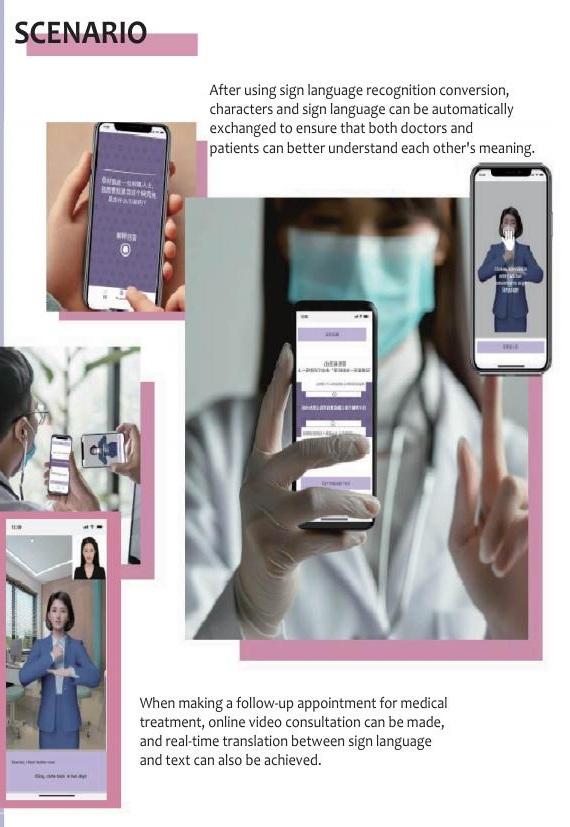
02 - Live Consultation

Translate meaning in both directions.

Sign-language recognition converts patient input into text, while provider responses can be displayed as readable text and visual sign-language guidance.

  • Sign language to written text
  • Text and visual confirmation
  • Clear pause, repeat, and correction states
Deaf Connect real-time sign language translation scenario

03 - Follow-up Care

Keep medical information accessible after the conversation ends.

Patients can review the diagnosis, treatment guidance, and prescription information, then return through video consultation with the same translation support.

  • Visual diagnosis summary
  • Prescription and treatment record
  • Translated video follow-up
Deaf Connect final interface and follow-up scenario board

Impact & Takeaways

Deaf Connect turns accessibility from a special request into a continuous care pathway.

The final concept reduces the number of moments when patients must improvise communication and gives providers a clearer way to confirm that critical medical information was understood.

Task Completion0%

Improvement recorded during prototype evaluation of the medical journey.

Core Journey0

Appointment, consultation, and follow-up combined into one accessible experience.

Translation0

Sign-to-text and text-to-sign communication supported in the same consultation flow.

Patient Independence

Accessible preparation reduces dependence at the point of care.

Patients can communicate needs before arrival and retain visual information after the visit, reducing repeated explanations.

Provider Confidence

Confirmation becomes part of the interaction.

Translation states and persistent records help providers verify meaning instead of assuming a spoken exchange was understood.

Reflection

What I learned from designing around communication equity.

What I Learned

Accessibility is strongest when it shapes the system, not only the interface.

The most important shift was moving beyond a translator screen. Booking, wayfinding, medical explanation, and follow-up all had to preserve the same accessible context.

Future Improvement

Validate language variation, privacy, and clinical accuracy.

The next phase should include Deaf participants, interpreters, and clinical staff to test regional sign variation, correction flows, sensitive-data handling, and emergency use.