Back

Product Strategy - UX Research - Interaction Design

Peloton Reimagined turns workouts into a season-based competitive fitness league.

A platform strategy that moves Peloton beyond premium hardware by combining structured competition, visible progress, and community belonging.

Role
Product Strategy & UX
Scope
Research, Strategy, Product Design
Team
Qiuqi Sun, Zehan Lu, Yanxun Wang
Tools
Figma, Business Frameworks
Timeline
Semester Project
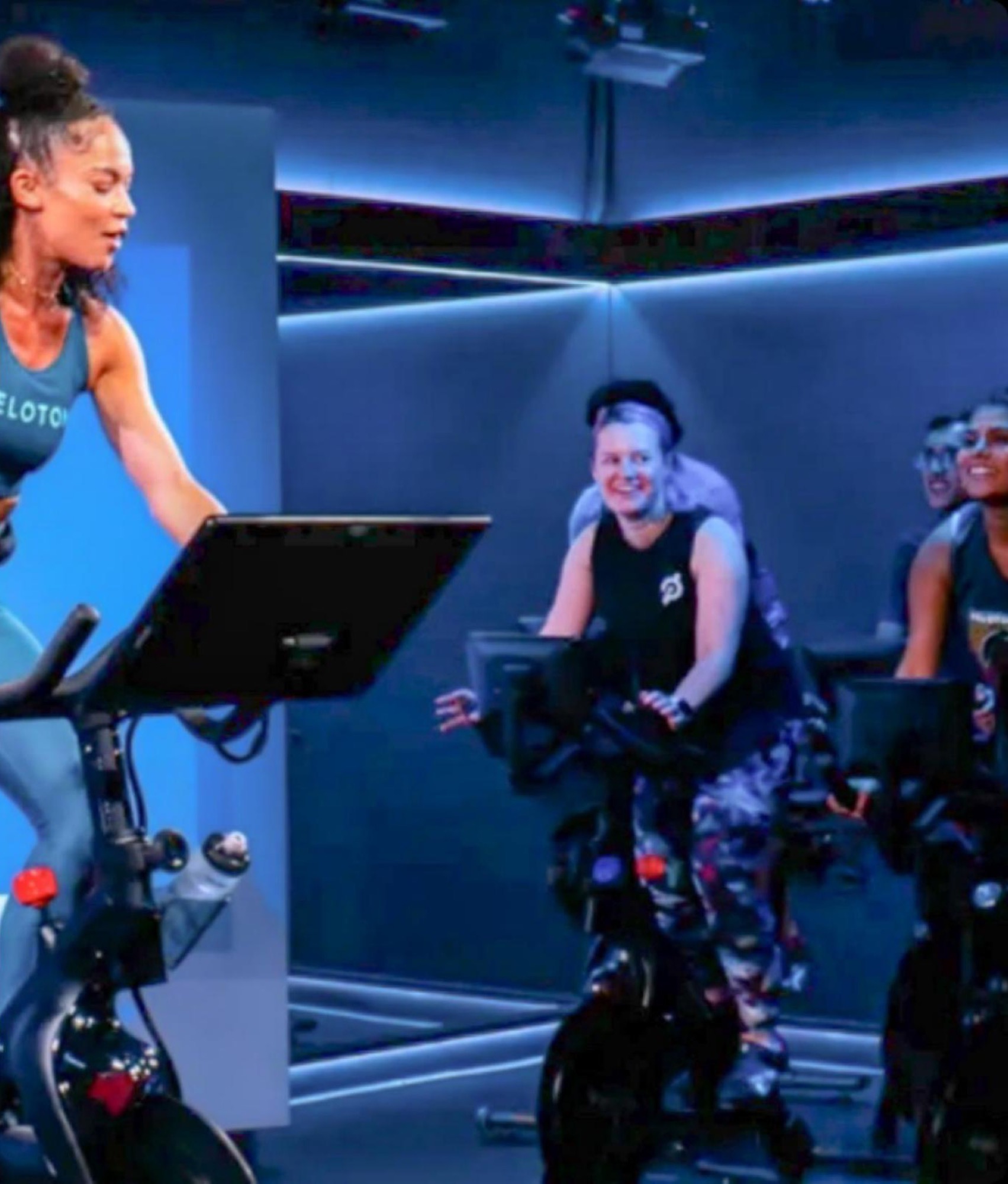
Peloton instructor leading a studio cycling class
Peloton Reimagined From hardware brand to competitive fitness ecosystem.

Overview

The Context

Peloton built a category-defining brand around premium connected equipment. After the pandemic, that hardware-first model became a barrier: the market normalized, the audience narrowed, and free workout content became easier to substitute.

The opportunity was not simply to sell more bikes. It was to make Peloton's instructors, classes, and community valuable on any equipment and in any location.
What We Did

Our three-person team combined market research, behavioral theory, persona synthesis, and business strategy frameworks to identify the strongest long-term engagement opportunity.

We translated the strategy into a season-based fitness league with ranked matches, weekly goals, city championships, social teams, and tiered subscriptions.

Problem

Peloton gave people workouts, but not enough reason to return every week.

The experience depended on expensive equipment and one-way content. When motivation dropped, users could not see a clear goal, meaningful progression, or shared commitment.

01

Hardware Trap

Premium equipment limited access and reinforced the perception that no bike meant no Peloton.

02

Engagement Gap

On-demand classes offered choice, but little structure, commitment, or visible progression.

03

Replaceable Content

Without a stronger system around the classes, free workout alternatives could satisfy the same basic need.

Research

The market was shifting from equipment ownership to flexible, recurring access.

We reviewed Peloton's business position, fitness behavior trends, competitive forces, and the needs of people who wanted guided workouts without buying premium hardware.

0% Valuation decline

From Peloton's pandemic peak, revealing the limits of hardware-led growth.

$2K+ Equipment barrier

Many guided-workout users were unwilling to enter through premium equipment.

0 Market shifts

AI, wearables, hybrid fitness, subscriptions, gamification, and recovery.

Strength

Content people trust

Recognizable instructors, polished classes, a strong community, and a distinctive brand identity.

Weakness

A narrow entry point

High equipment costs, hardware dependence, and a product identity tied too closely to one device.

Opportunity

Platform-first access

App-only growth, corporate wellness, hybrid workouts, and community competition can expand reach.

Threat

A crowded red ocean

Gyms, free content, connected equipment, and high buyer power make passive workout libraries easy to replace.

Personas

Three routines revealed the same motivation problem.

Each persona wanted flexibility, but none had a durable reason to turn intention into a weekly habit.

Primary Persona

Carlos, 33

Urban Professional

Long workdays leave him mentally exhausted. He needs short, structured sessions that remove planning and create momentum.

"I need a workout that tells me what matters today."
Secondary Persona

Emily, 45

Working Parent

Family interruptions make rigid schedules unrealistic. She needs flexible, low-pressure goals that still feel meaningful.

"I need progress that survives an unpredictable week."
Secondary Persona

Alex, 30

Remote Creative

A flexible but unstructured routine makes consistency difficult. Alex needs external motivation and light accountability.

"I can work out anytime, so I keep putting it off."

Pain Points

Flexibility without structure made commitment fragile.

01

No weekly structure

Users chose individual classes without a larger training path.

02

Invisible progress

Completed workouts did not clearly build toward a meaningful milestone.

03

Passive participation

Leaderboards displayed results, but did not create an active competitive event.

04

Weak accountability

Solo sessions offered little social pressure or shared reason to return.

Insight

People do not quit because exercise is hard. They quit when progress loses meaning.

Behavioral research pointed to three needs: competence through visible progress, belonging through social participation, and a repeatable cue-action-reward loop. Competition could connect all three without making the core workout harder to access.

The Root Cause

Peloton behaved like a library of workouts, not a system that builds commitment.

The missing layer was a recurring structure that turns each workout into progress, each week into a shared event, and each season into a reason to return.

Visible Progress Weekly Commitment Social Competition Platform Access

Design Goal

Turn Peloton into a fitness league, not just another workout platform.

The concept needed to work for app-only members and hardware owners while creating a repeatable commitment loop that Peloton could also monetize beyond equipment sales.

01

Season

A fixed competitive cycle gives training a beginning and an end.

02

Weekly Match

Scheduled challenges turn intention into a recurring appointment.

03

Ranking

Performance becomes visible against personal, team, and city goals.

04

Promotion

Progress unlocks status, rewards, and a reason to enter the next week.

Strategic Validation

Four business lenses supported the platform direction.

STP

Focused Audience

Prioritize competitive Gen Z, corporate teams, hybrid users, and cost-conscious app-first members.

Blue Ocean

New Category

Move beyond passive content by combining connected fitness with league-based competition.

Lean Canvas

Recurring Value

Build retention and revenue around ongoing participation rather than one-time hardware conversion.

Five Forces

Clear Differentiation

Reduce substitution risk by making community, ranking, and seasons difficult to replace with free videos.

Solution

A season-based competitive fitness experience built inside the Peloton app.

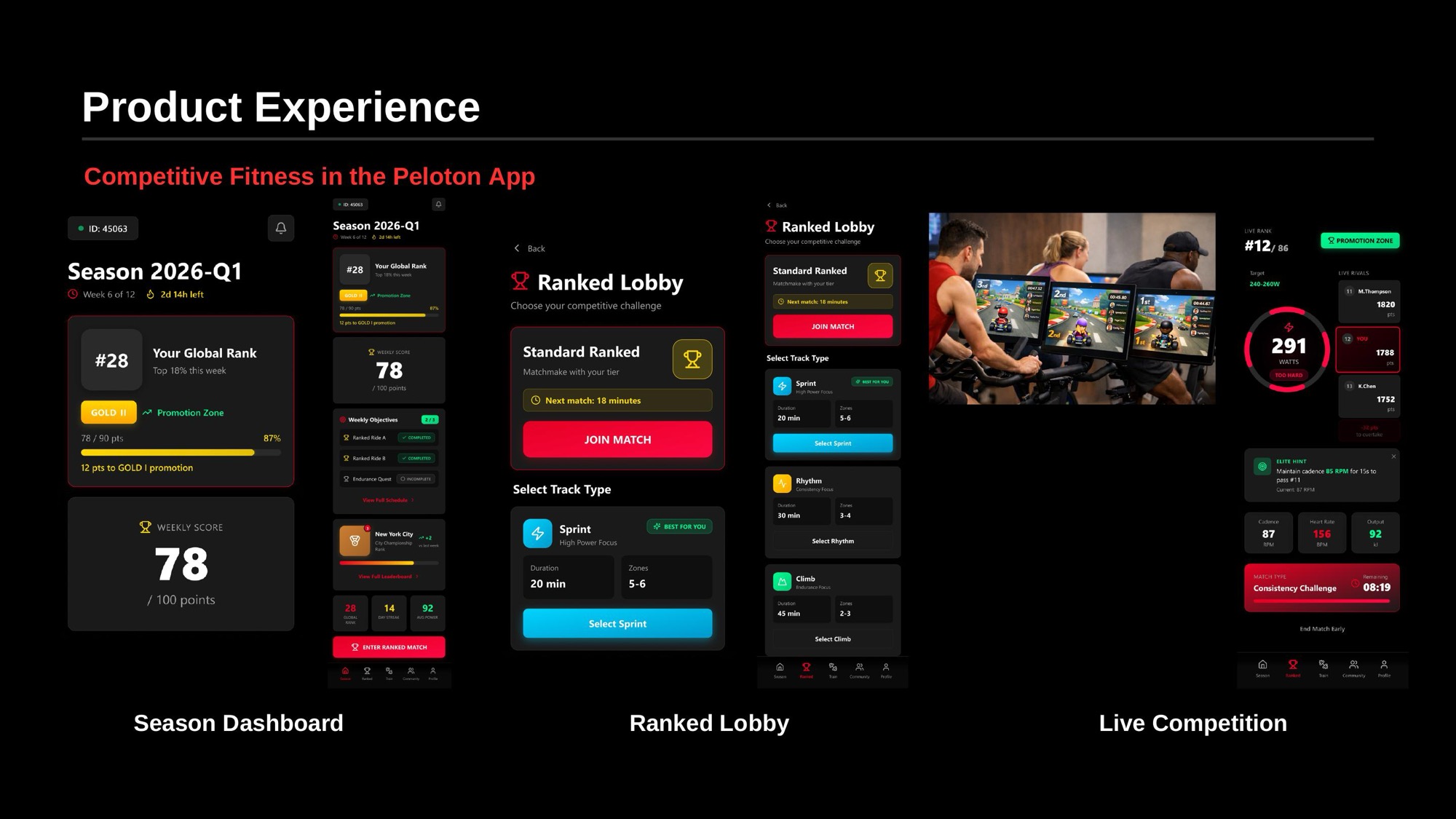
The final product connects season progress, ranked workouts, live performance, weekly objectives, city leagues, and social teams in one participation loop.

Peloton product experience showing season dashboard, ranked lobby, and live competition
Season dashboard, ranked lobby, and live competition.

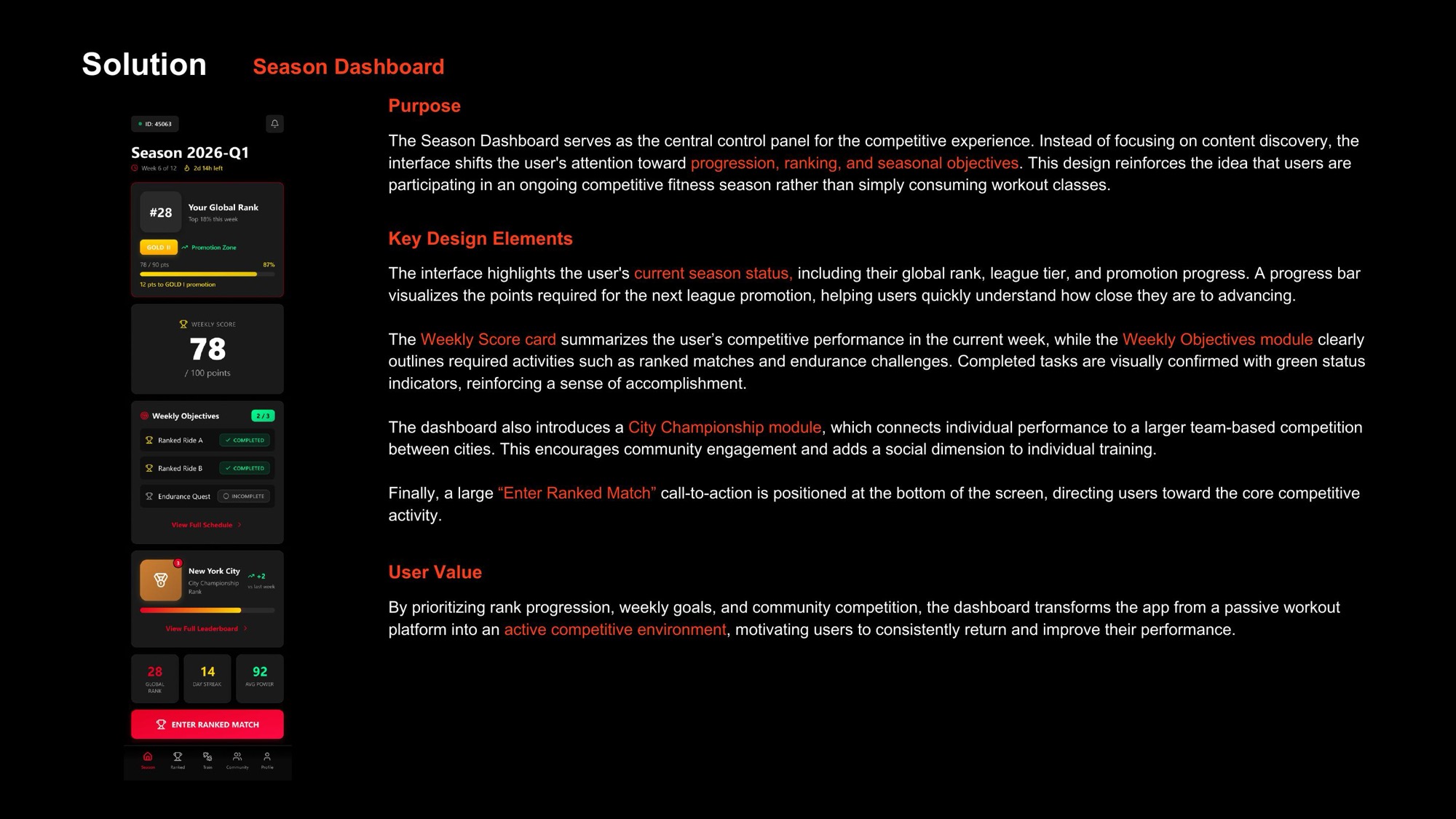
01 - Season Dashboard

Make long-term progress visible.

Members see their global rank, league tier, promotion zone, weekly score, and city contribution before choosing the next match.

  • One season-level goal
  • Clear weekly objectives
  • Visible promotion progress
Peloton season dashboard concept

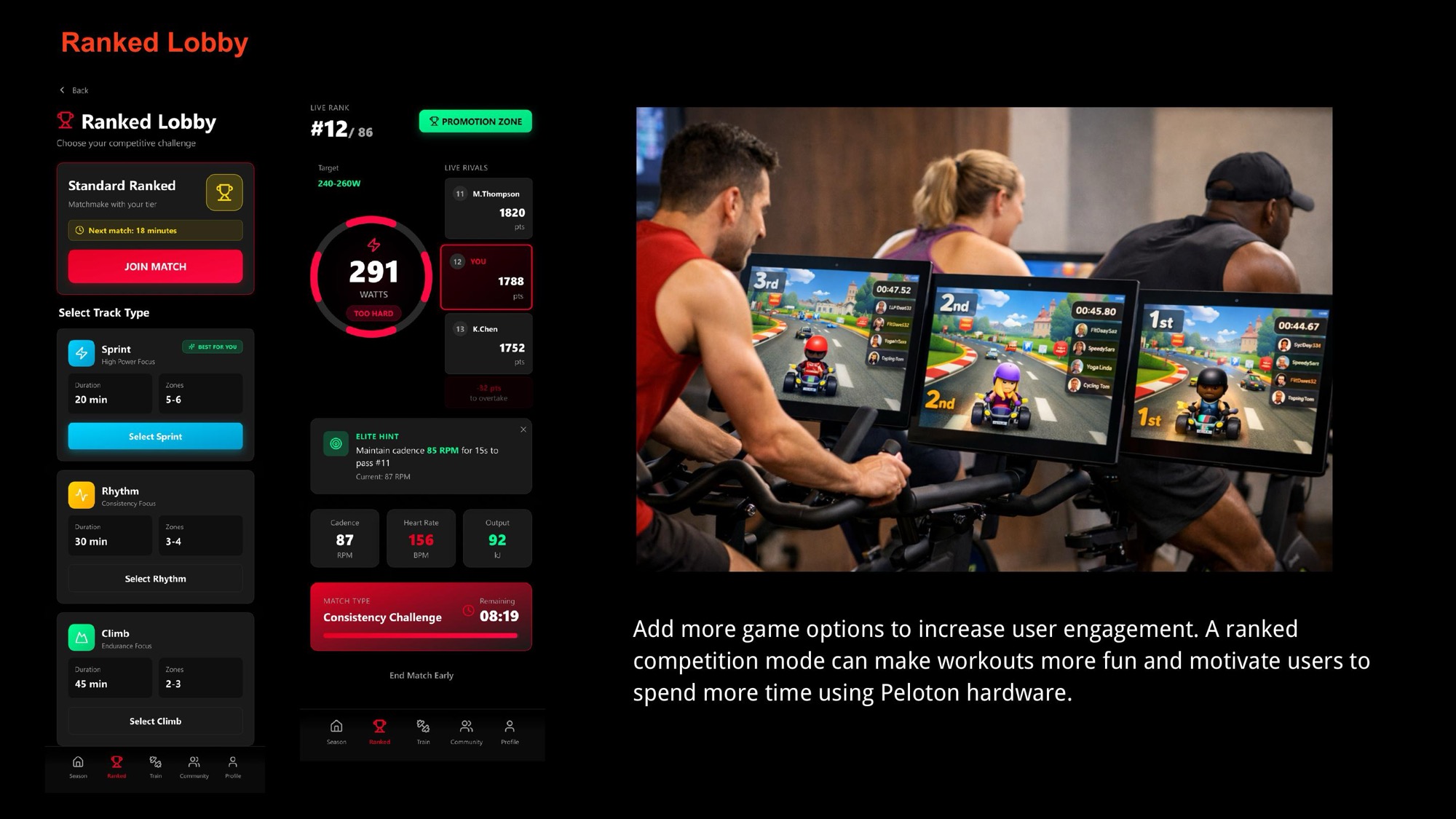
02 - Ranked Lobby

Turn a workout into a scheduled event.

Members choose Sprint, Rhythm, or Climb matches, see when the next round begins, and enter with a clear competitive objective.

  • Matchmaking by level
  • Multiple workout formats
  • Live rivals and performance data
Peloton ranked lobby and live competition concept

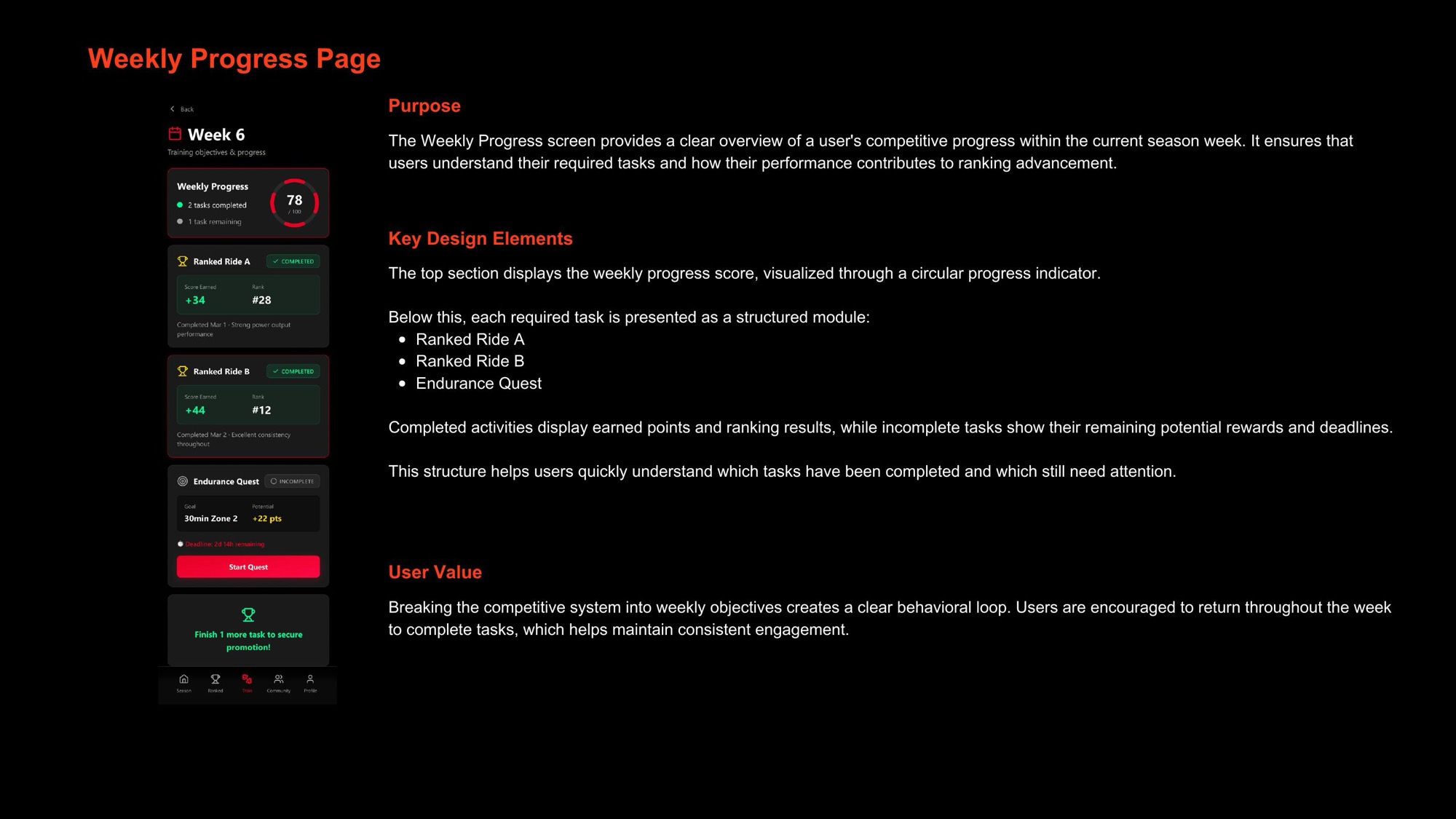
03 - Progress & Promotion

Make every completed session count.

Weekly challenges contribute points to a season score, helping members understand exactly how one workout moves them toward the next tier.

  • Weekly score and quests
  • Completed and incomplete states
  • Points tied to rank movement
Peloton weekly progress concept

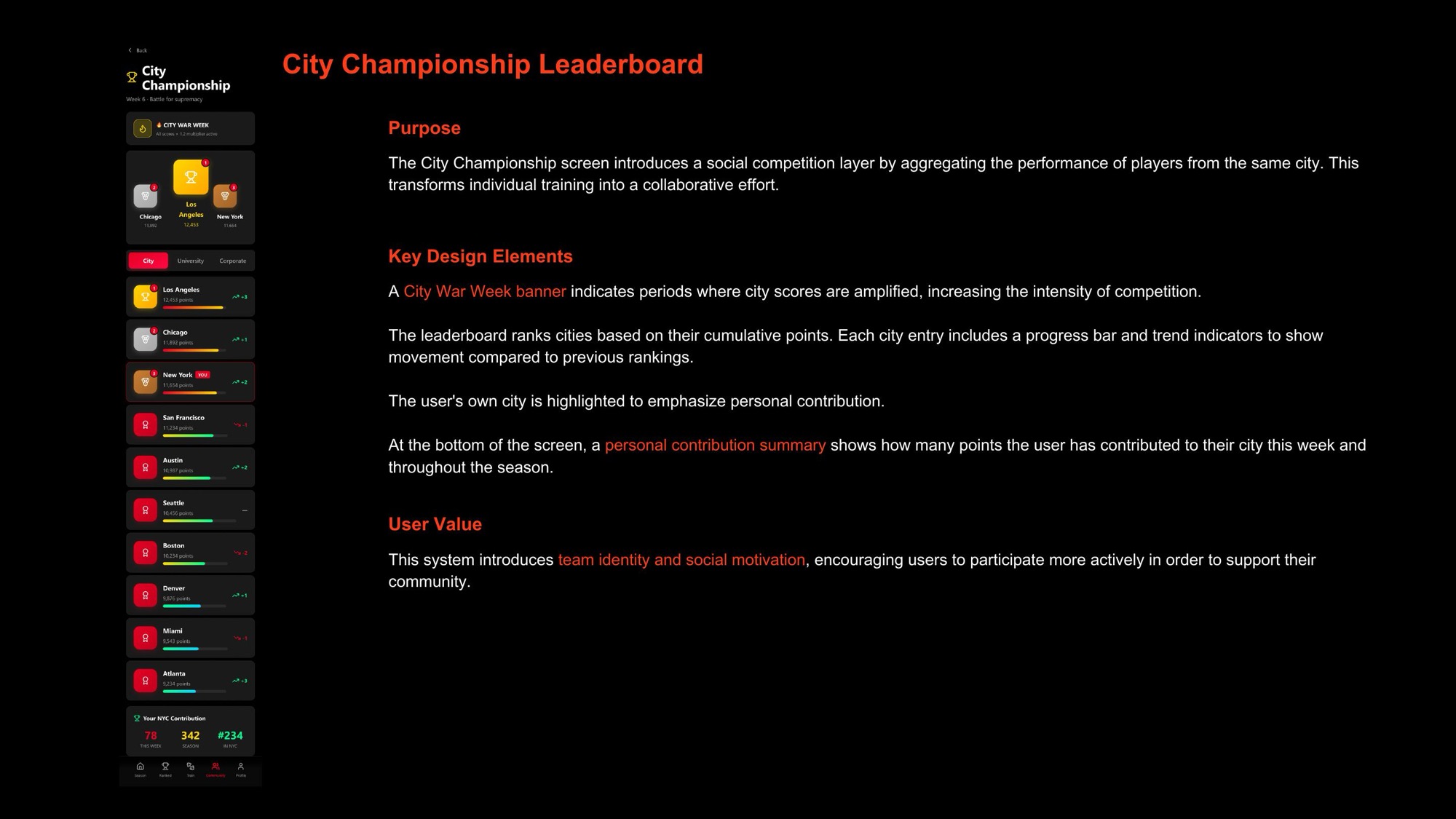
04 - City Championship

Scale individual effort into community belonging.

Local rankings give members a shared identity. Personal activity contributes to a visible city total, creating both accountability and collective reward.

  • City, university, and corporate leagues
  • Personal contribution summary
  • Live team movement on the leaderboard
Peloton city championship leaderboard concept

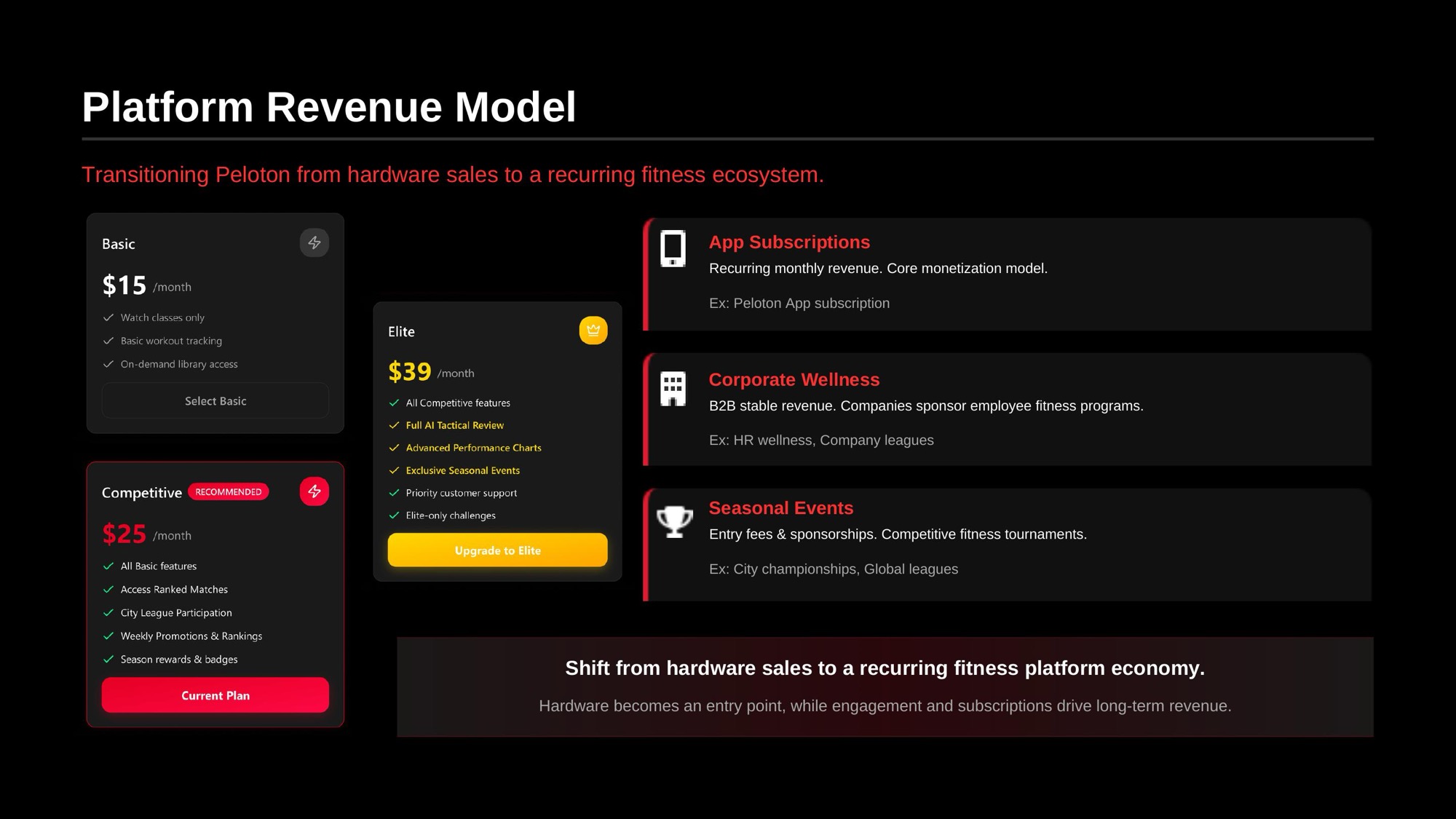
Platform Model

Hardware becomes one entry point, while participation drives recurring value.

Basic access preserves the class library. Competitive and Elite tiers add ranked matches, performance analysis, seasonal events, and stronger community participation.

Peloton platform revenue model with subscription, corporate wellness, and seasonal event revenue
App subscriptions, corporate wellness, and seasonal events create recurring revenue.
Basic

Content Access

On-demand classes and workout tracking keep entry friction low.

Competitive

League Access

Ranked matches, city leagues, promotions, and seasonal rewards support retention.

Corporate

Team Wellness

Company leagues and bulk access turn participation into a B2B wellness product.

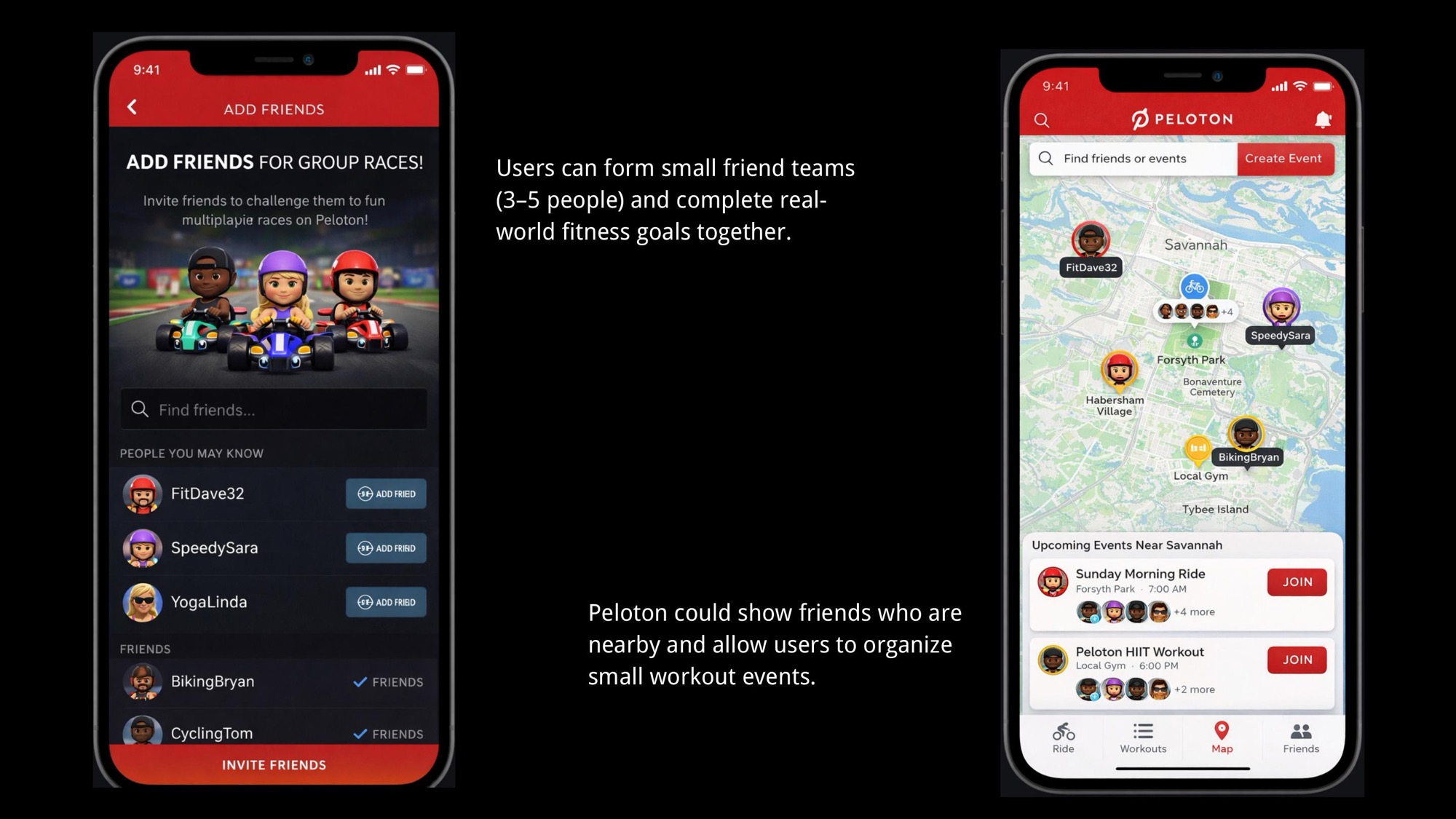
Peloton small team and local community concepts

Social Layer

Competition works best when it still feels personal.

Small friend teams, nearby events, and real-world group goals give the league a human scale. Members can compete globally while staying accountable to people they know.

3-5 Person Teams Local Events Shared Goals

Impact & Takeaways

The concept gives Peloton a reason to be used every week, with or without a bike.

The strategy expands access without weakening the premium brand. Classes remain the core product, while seasons, rankings, and teams create the commitment layer that passive libraries lack.

Retention

Weekly reasons to return

Season progress and scheduled matches turn isolated sessions into an ongoing commitment.

Growth

App-first participation

Members can enter through software, a gym, or existing equipment instead of a premium bike purchase.

Community

Shared competitive identity

City, company, university, and friend leagues connect personal effort to a larger team.

Business

Recurring platform revenue

Subscriptions, corporate wellness, and seasonal events diversify value beyond hardware sales.

Reflection

What I learned from connecting product behavior to business strategy.

What I Learned

Engagement needs a meaningful structure, not more content.

Peloton already had strong instructors and classes. The more valuable design move was creating a system that gives those assets progression, stakes, and social meaning.

Future Improvement

Validate competition intensity across different fitness identities.

The next step would be prototype testing with app-only users, hardware owners, corporate teams, and less competitive members to tune matching, rewards, and privacy.